
The Curious Observer vs The Vigilant Watchdog
- Connie Boczarski, DC
- Jan 22
- 3 min read
When it comes to brain and nervous system retraining, one of the most transformative shifts you can make isn't about what you think—it's about how you relate to your thoughts. Many people embarking on this journey assume that success means catching and correcting every negative thought that crosses their mind. They become hypervigilant, constantly scanning their mental landscape for problems to fix. But this approach, which I call the "vigilant watchdog", often backfires.

The vigilant watchdog operates from a place of fear and urgency. Like a guard dog that barks at every shadow, this part of you stays on high alert, ready to pounce on any thought that seems "wrong" or "negative." You might find yourself thinking: "There's that catastrophic thought again—I need to stop it!" or "Why am I still thinking this way? I should be better by now!" This constant monitoring and immediate correction feels productive, like you're actively working on changing your thinking patterns, but this approach actually activates your limbic system and revs up your nervous system rather than calming them down.
Here's why the watchdog approach is counterproductive: your brain interprets this hypervigilance as confirmation that there's a real threat to guard against. Each time you react to a negative thought with urgency and correction, you're essentially telling your nervous system, "This is dangerous! Stay alert!" The very act of trying to catch and fix every unwanted thought keeps you in a state of sympathetic nervous system activation—the opposite of what you're trying to achieve. You end up exhausted, frustrated, and often more anxious than when you started.
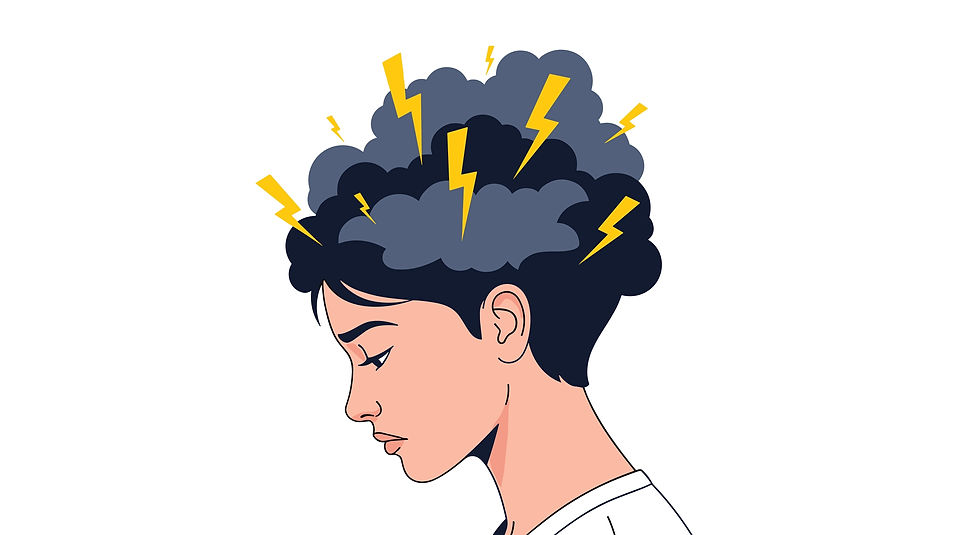
Enter the curious observer—a fundamentally different way of relating to your inner experience. The curious observer is non-judgmental, kind, compassionate, and supportive. Rather than reacting to thoughts as problems to be solved, the curious observer simply notices them with gentle interest. "Oh, there's that worry about the future again" or "I notice I'm having thoughts about not being good enough." There's no urgency, no self-criticism for having the thought in the first place. The curious observer recognizes that thoughts are just mental events, not threats that require immediate fixing.
One of the things makes the curious observer so powerful is that it allows you to step back and see patterns rather than getting lost in individual thoughts. When you're not frantically trying to redirect every negative thought, you gain the mental space to notice: "I tend to scan for symptoms in the morning" or "My inner critic gets loud when I feel I've made a mistake" or "I often spiral into rumination after talking with certain people." These broader patterns are where the real work happens. By observing trends rather than battling individual thoughts, you can address patterns and make genuine, lasting changes to your neural pathways.

The curious observer also honors a simple truth: it's impossible to catch every negative thought, and trying to do so sets you up for failure. Your brain generates thousands of thoughts each day, many of them automatic and subconscious. You can't police them all, nor should you try. What you can do is cultivate a different relationship with your thoughts—one where they don't have so much power over you. When you observe and respond, rather than react, you create space between stimulus and response. In that space lies your freedom to choose a different pattern, not through force, but through gentle redirection and self-compassion.
The shift from vigilant watchdog to curious observer takes time, it often feels wrong at first, and that you should be working harder. But as you practice this softer approach, something remarkable happens: your brain and nervous system begin to settle. You stop treating your brain as an adversary and start treating it as something worthy of curiosity and care. And paradoxically, this gentle, observant stance leads to more genuine change than all the forceful thought-policing. Your brain retrains best not through vigilance and harsh correction, but through loving, compassionate awareness and gentle redirection.

Want to learn more about being the curious observer instead of the vigilant watchdog and other things you can do to support your recovery?
Sign up for my upcoming Recovering Together Class:
Let's Stay In Touch!
Get Notified of New Offerings and Blog Posts:


Comments